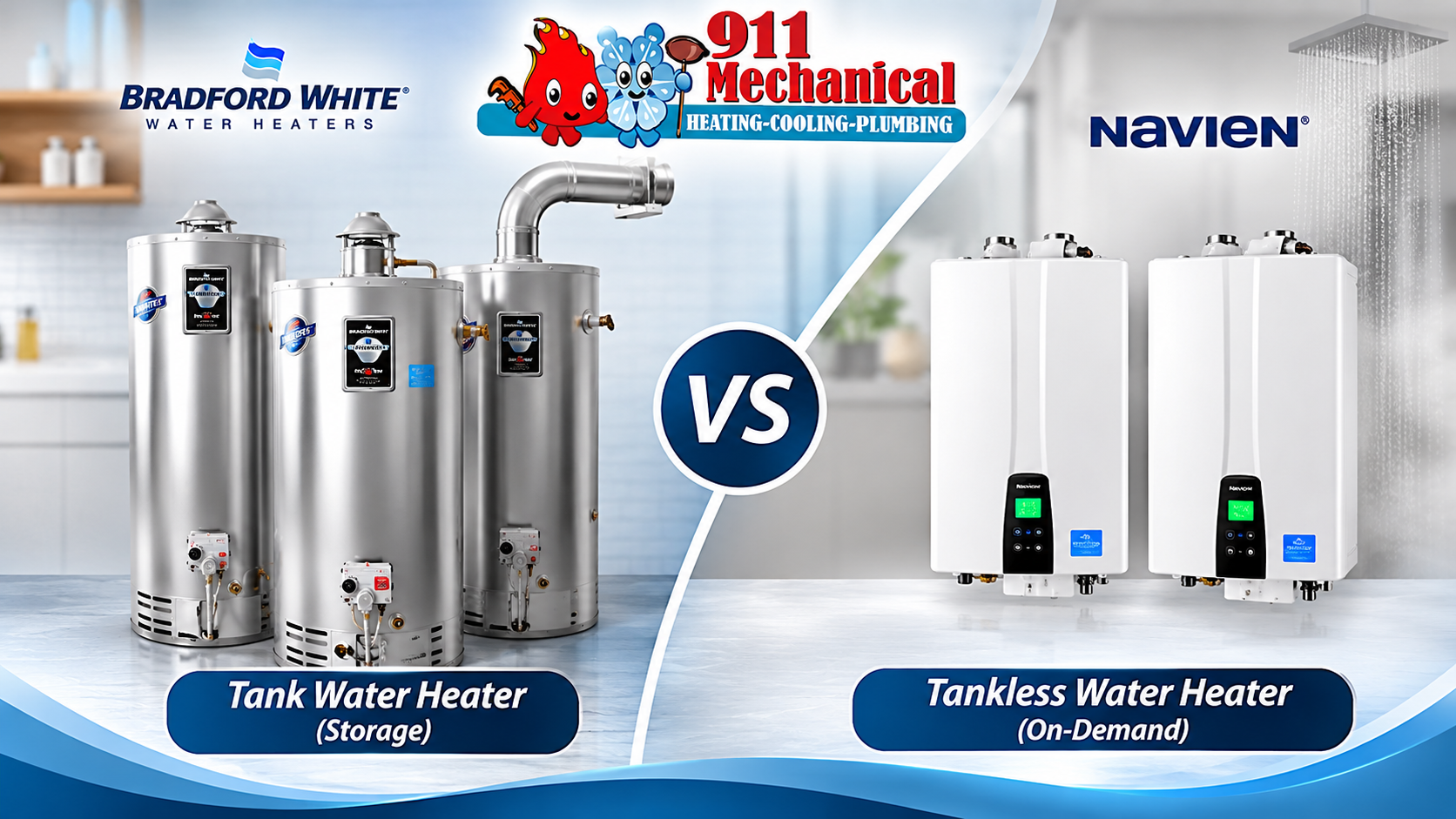
Tankless vs Tank Water Heater: Which Is Better for Your Michigan Home?
If you are replacing your water heater, you may be wondering:
Should I choose a tankless water heater or a traditional tank water heater?
Both can provide reliable hot water, but they work very differently.
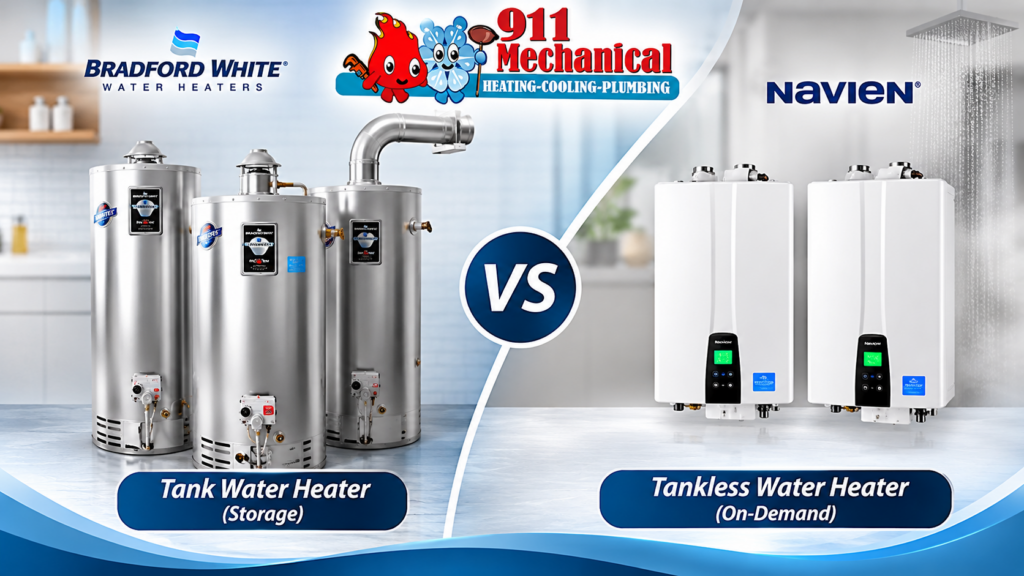
A traditional tank water heater stores a supply of heated water so it is ready when you need it.
A tankless water heater heats water as you use it instead of storing a large amount of hot water.
The better choice depends on your household’s hot-water demand, available space, existing gas and plumbing setup, budget, and how you use hot water.
At 911 Mechanical, we install and service water heaters throughout Metro Detroit and can help you compare a traditional tank water heater with a tankless system based on your home’s actual needs.
Tankless vs Tank Water Heater: What’s the Difference?
The biggest difference is how each system handles hot water.
Traditional Tank Water Heater
A traditional water heater stores heated water inside a tank.
A common residential tank may hold around 40 gallons of water.
As hot water is used, the system continues heating incoming cold water. Because of this recovery process, a 40-gallon tank can provide more than its actual stored capacity over time.
However, once the available hot water is used faster than the tank can recover, you may have to wait for the water heater to heat more water.
Depending on the equipment and conditions, recovery can take roughly 30–60 minutes.
Tankless Water Heater
A tankless water heater does not store a large supply of heated water.
Instead, it heats water as it flows through the system.
This means you can have a continuous supply of hot water without waiting for a storage tank to fully recover—as long as the system is properly sized for your home’s demand.
But there is an important detail:
Tankless does not mean unlimited GPM.
A tankless water heater has a maximum flow rate measured in gallons per minute (GPM).
If your household uses more hot water at the same time than the system can provide at the required temperature rise, performance can be affected.
That is why proper sizing is extremely important.
Tankless vs Tank: Quick Comparison
Feature | Tank Water Heater | Tankless Water Heater |
Hot water storage | Stores heated water | Heats water on demand |
Hot water supply | Limited by tank capacity and recovery | Continuous within rated GPM |
Recovery time | Can take approximately 30–60 minutes after heavy use | No traditional tank recovery period |
Upfront cost | Generally lower | Generally higher |
Space required | Larger footprint | More compact |
Standby heat loss | Yes | Reduced because water is not continuously stored hot |
GPM limitation | Not typically the main limitation | Important sizing factor |
Installation | Often simpler when replacing an existing tank | May require gas, venting, plumbing or electrical changes |
Long-term energy use | Depends on equipment and usage | Can reduce energy wasted keeping stored water hot |
Best for | Homes wanting lower upfront cost and familiar equipment | Homes wanting on-demand hot water and space savings |
How Much Does a Tank vs Tankless Water Heater Cost?
Cost is one of the biggest differences between the two options.
For planning purposes, a standard tank water heater installation typically starts around $2,000.
Tankless water heater installations typically start around $4,000, with many installations closer to $4,600. More complex installations can reach $6,000 or more depending on the equipment and work required.
These are planning ranges, not guaranteed prices.
The final cost can depend on:
- Water heater size
- Type of equipment
- Gas-line requirements
- Venting
- Electrical capacity
- Plumbing modifications
- Installation location
- Removal of existing equipment
- Code and installation requirements
A tankless system usually costs more upfront, but homeowners may choose it because of its on-demand operation, compact size, and potential energy savings.
How Does GPM Affect a Tankless Water Heater?
This is one of the most important things Michigan homeowners should understand before choosing tankless.
GPM means gallons per minute—the amount of hot water a tankless water heater can deliver at a given time.
A tankless water heater is sized based on the home’s hot-water usage at any one time. That means the total GPM demand from showers, faucets, tubs, and other fixtures needs to be considered when selecting the system.
Once properly sized, a tankless system can provide hot water continuously for as long as water is flowing, as long as the home’s demand stays within the unit’s rated GPM capacity. Unlike a traditional tank, it does not have a fixed total number of gallons of hot water stored in the tank.
For example, a homeowner who enjoys long showers or has a large 50–80 gallon tub may benefit from a properly sized tankless system because there is no fixed tank volume that can simply run out. The system can continue producing hot water at its operating temperature, such as 120°F, as long as the flow remains within its rated GPM capacity.
The important limitation is GPM, not a total gallon storage limit. If multiple fixtures are running at the same time and the combined demand exceeds the tankless unit’s rated GPM at the required temperature rise, the system may not be able to maintain the expected hot-water performance.
That is why proper sizing based on the home’s actual simultaneous hot-water demand is one of the most important parts of a tankless water heater installation.
Tankless vs Tank Water Heater FAQs
1- Is a tankless water heater better than a tank water heater?
Not for every home. Tankless systems can provide continuous hot water within their rated GPM capacity and can reduce standby heat loss, while traditional tank water heaters generally have a lower upfront installation cost. The right choice depends on your household’s hot-water demand, budget, available space, and existing setup.
2-How many GPM do I need for a tankless water heater?
It depends on how many fixtures you expect to use at the same time and the required temperature rise. Showers, faucets, tubs, and appliances can all contribute to your home’s total GPM demand. A professional should size the system based on your actual simultaneous hot-water usage.
3- Can a tankless water heater run out of hot water?
A properly sized tankless system can provide hot water continuously as long as water is flowing and the home’s demand remains within the unit’s rated GPM capacity. Unlike a tank water heater, it does not have a fixed number of gallons stored in the tank.
4- Can a tankless water heater handle a 50–80 gallon bathtub?
It can, provided the system is properly sized for the tub’s flow rate and required temperature rise. A tankless system does not need to store 50–80 gallons of hot water in advance. It can continue producing hot water while the tub is filling, as long as the flow remains within the unit’s rated GPM capacity.
5- What happens if I use too much hot water at once with a tankless system?
If the combined demand from multiple fixtures exceeds the unit’s rated GPM at the required temperature rise, the system may not be able to maintain the expected hot-water temperature and flow. Proper sizing is the best way to avoid this problem.
6- How much does a tankless water heater cost in Michigan?
Tankless installations typically start around $4,000, with many installations closer to $4,600. More complex installations can reach $6,000 or more depending on equipment, gas-line requirements, venting, electrical capacity, plumbing modifications, and other installation requirements.
7- How much does a traditional tank water heater cost?
Standard tank water heater installation typically starts around $2,000, depending on the equipment and installation requirements.
8- Are tankless water heaters good for Michigan homes?
Yes, when properly selected and installed. Michigan’s colder incoming water temperatures make proper sizing especially important because the system needs to provide the required temperature rise while meeting the home’s GPM demand.
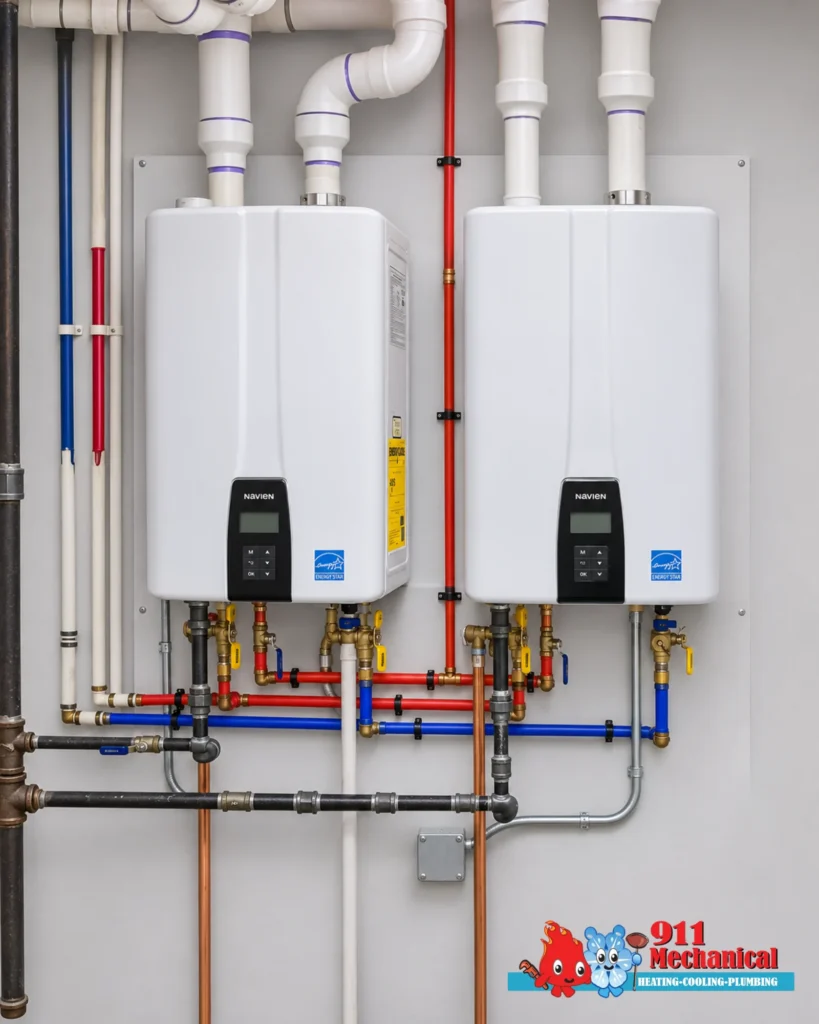
9- Why does 911 Mechanical install Navien tankless water heaters?
911 Mechanical installs Navien tankless water heaters because of their efficiency, performance, and warranty coverage. Proper sizing and professional installation are also important parts of getting reliable performance from a tankless system.
10- Should I replace my tank water heater with a tankless system?
It depends on your household’s hot-water demand, budget, available space, existing gas and plumbing setup, and long-term goals. If your current tank is approaching replacement, it can be a good time to compare both options before making a decision.
Get an Accurate Water Heater Estimate in Metro Detroit
Online prices can help you plan, but the actual water heater cost depends on your home and the installation requirements.
At 911 Mechanical, we evaluate your current water heater, household hot-water demand, GPM requirements, installation location, existing utilities, and equipment options before recommending a system.
We provide professional water heater installation throughout Metro Detroit.
If you are considering replacing a traditional tank water heater, upgrading to tankless, or simply want to understand which option makes sense for your home, our team can help you compare the choices.
Call 911 Mechanical at 586-247-7300 to schedule your free, no-obligation in-home estimate