How Much Does a Tankless Water Heater Cost in Michigan?
If you are considering an on-demand water heater, one of your first questions is probably:
How much does a tankless water heater cost in Michigan?
For 911 Mechanical customers, a tankless water heater installation typically starts around $4,000, with many installations closer to $4,600. Depending on the equipment, installation requirements, and needs of the home, a tankless installation can reach $6,000 or more.
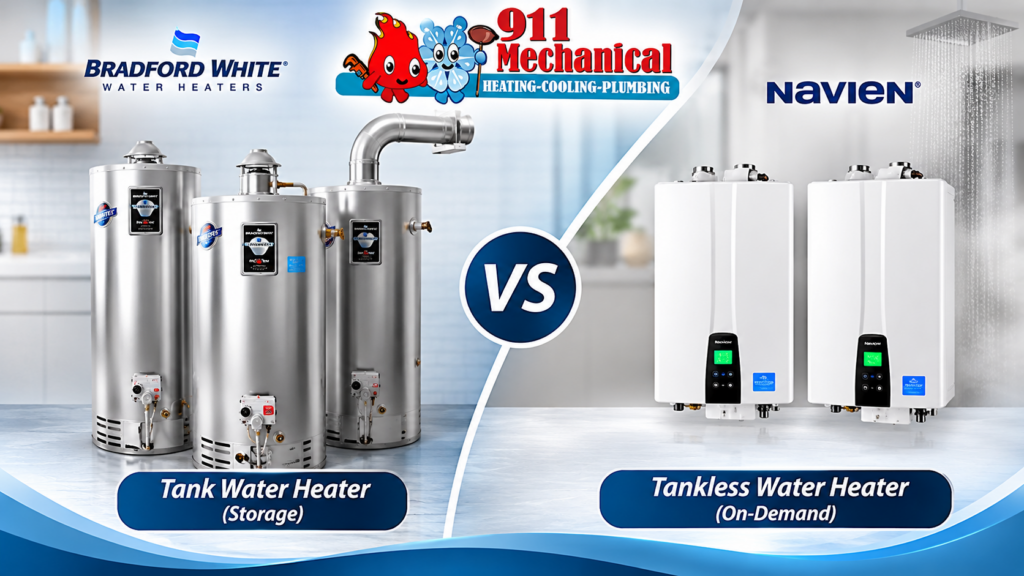
A standard tank-style water heater replacement typically starts around $2,000, making tankless systems a higher-upfront-cost option.
Your actual tankless water heater installation cost depends on the size and type of unit, your household’s hot-water demand, fuel source, existing gas or electrical capacity, venting requirements, plumbing modifications, and installation location.
At 911 Mechanical, we provide free in-home estimates so you can understand the equipment and installation requirements before making a decision.
What Is the Average Tankless Water Heater Installation Cost?
Tankless water heaters generally require a larger upfront investment than standard tank-style water heaters.
As a general planning range:
Water Heater Type | Typical Starting Point |
Standard tank water heater | Starting around $2,000 |
Tankless water heater | Starting around $4,000 |
Many tankless installations | Around $4,600 |
More complex tankless installations | Up to $6,000+ |
These are planning figures rather than guaranteed prices. The final price of a tankless water heater installed in your home depends on the equipment selected and the work required to install it properly.
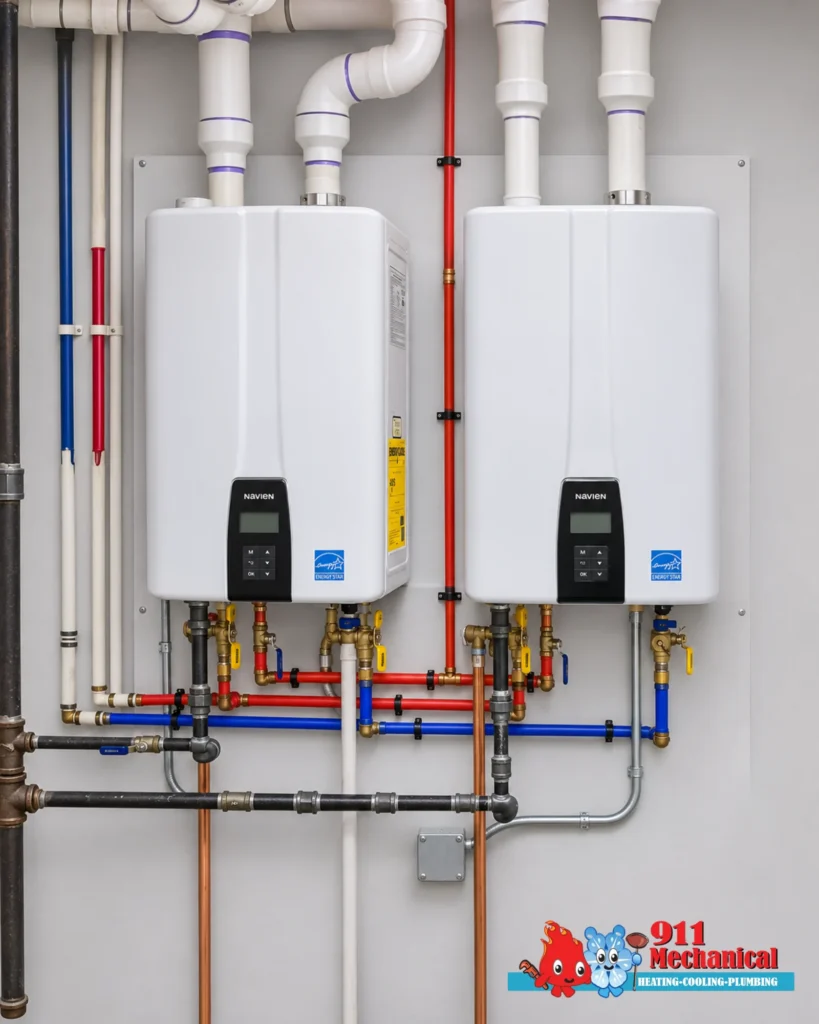
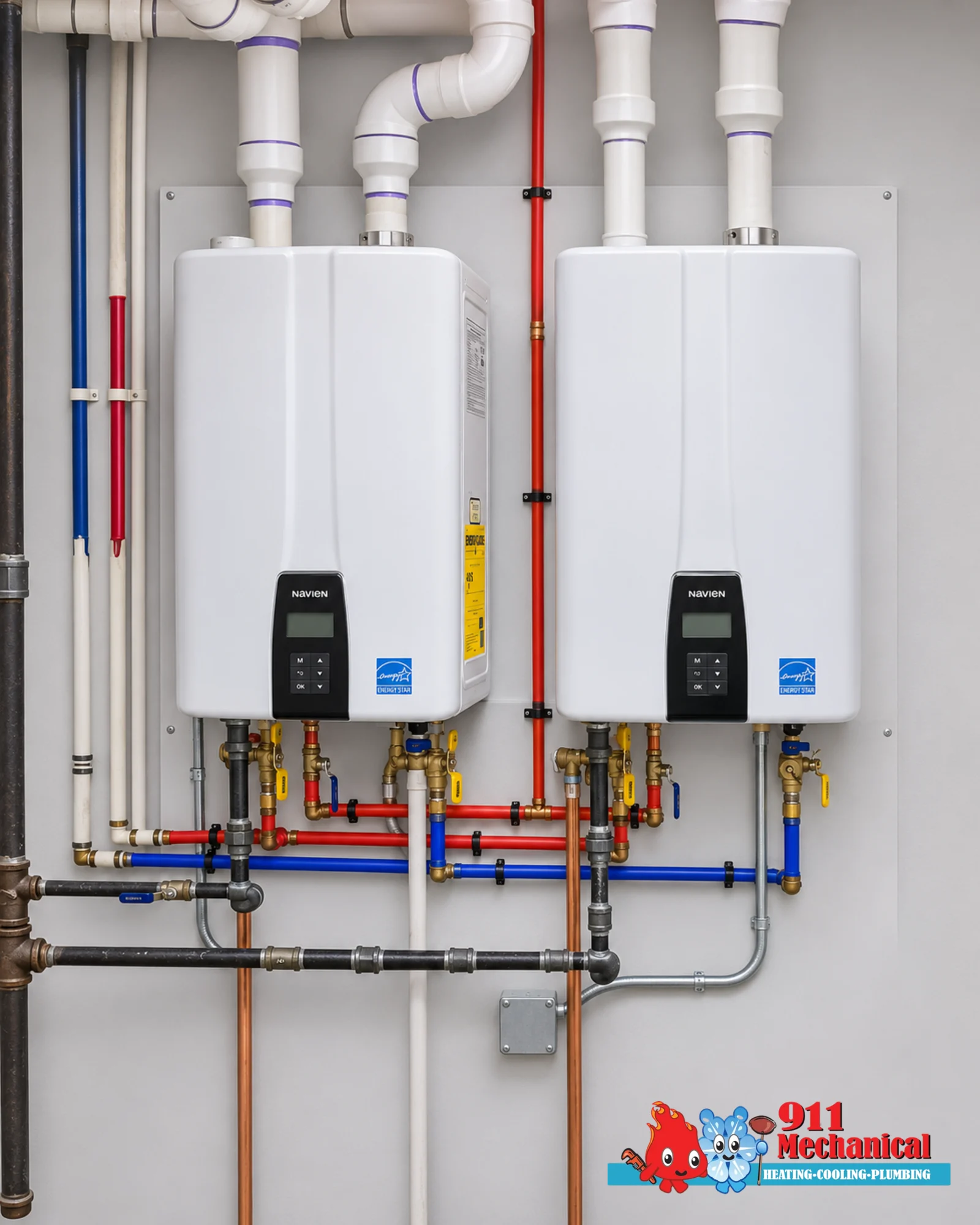
A tankless conversion may require additional gas-line work, venting, electrical work, plumbing modifications, or other installation requirements.
What Affects Tankless Water Heater Cost?
1. The Size and Flow Rate of the Tankless Water Heater
Tankless systems should be sized based on gallons per minute (GPM) rather than simply the size of the home.
GPM refers to how much hot water the system can provide at one time.
For example, a household might have a shower using 2.5 GPM while another fixture is using 1.5 GPM. If multiple showers, sinks, or appliances are running at the same time, the tankless system needs to be capable of handling that combined demand.
Tankless water heaters provide hot water continuously, but they are limited by their maximum GPM capacity.
If the household demands more water than the unit is designed to handle, the system may reduce water flow to help maintain the desired temperature.
This is why proper sizing is so important.
The incoming water temperature also matters. Michigan’s colder incoming water temperatures can require the system to produce a larger temperature rise during winter.
At 911 Mechanical, our technicians size tankless systems based on household flow rate and hot-water usage rather than simply choosing a unit based on home square footage.
2. Gas vs. Electric Tankless Water Heaters
The fuel source can make a major difference in the cost of a tankless water heater and installation.
Gas Tankless Water Heater Installation
A gas-fired system may require:
- Gas-line modifications
- Appropriate venting
- Combustion-air provisions
- Condensate drainage on certain high-efficiency models
- Additional installation work when replacing a tank-style unit
Depending on the existing system, the gas line may need to be upgraded to properly supply the new tankless unit.
Venting must also meet the equipment manufacturer’s requirements and applicable codes.
Electric Tankless Water Heater Installation
An electric tankless system may avoid gas venting, but whole-home models can require substantial electrical capacity.
If the existing electrical panel or service cannot support the unit, upgrades can significantly affect the electric tankless water heater installation cost.
So gas is not automatically more expensive than electric—or vice versa. The existing infrastructure in your home matters.
3. Converting From a Tank Water Heater to Tankless
Replacing one tankless unit with another can be different from converting an older tank-style system to tankless.
A conversion may involve:
- Removing the existing tank
- Modifying water lines
- Relocating equipment
- Upgrading a gas line
- Adding new venting
- Adding electrical circuits where required
- Installing condensate drainage where required
These changes can increase the price to install a tankless water heater.
4. Installation Location and Accessibility
A tankless unit mounted in an open, easily accessible mechanical area may be easier to install than one located in:
- A tight utility closet
- A crawl space
- A difficult basement location
- An area requiring major plumbing rerouting
The existing location of your water heater can therefore affect the total installation cost.
5. Venting and Gas-Line Requirements
Gas tankless water heaters can have significantly higher input requirements than traditional tank-style equipment.
Depending on the existing system, your installer may need to determine whether the current gas line can properly support the new unit.
Venting must also meet the equipment manufacturer’s requirements and applicable codes.
These are important parts of a professional gas tankless water heater installation and should be included when evaluating the complete project—not treated as an afterthought.
Tankless vs. Standard Tank Water Heater: What Are You Paying For?
Tankless systems generally have a higher upfront installation cost than a standard tank water heater.
A standard tank water heater stores a supply of heated water in the tank. For example, a typical 40-gallon tank can provide close to 50 gallons of usable hot water during operation because the incoming cold water mixes with the heated water and the system continues recovering as hot water is used.
Once the available hot water is depleted, recovery can take roughly 30–60 minutes, depending on the tank and its performance.
A tankless system works differently.
Instead of storing a large amount of heated water, it heats water as it is needed. This means there is no tank that needs to be refilled and reheated after the stored supply is used.
A properly sized tankless system can provide continuous hot water with no normal tank recovery period, as long as the household stays within the system’s GPM capacity.
The tradeoff is the higher upfront installation cost.
The right choice depends on your:
- Budget
- Household hot-water demand
- Required GPM
- Available fuel or electrical capacity
- Space
- Long-term plans for the home
Are Tankless Water Heaters Better for the Environment?
Tankless water heaters can also be an attractive option for homeowners who want to reduce their home’s energy use and carbon footprint.
A traditional tank continuously stores and maintains a large amount of heated water. A tankless system heats water only when hot water is needed, reducing the need to keep a large tank of water hot throughout the day.
Tankless systems can therefore be an appealing choice for homeowners who are looking for a more energy-efficient water-heating solution and want to take steps toward reducing their home’s carbon footprint.
They can also help reduce energy use over time, depending on household usage, equipment efficiency, fuel costs, and other factors.
Why Does 911 Mechanical Install Navien Tankless Water Heaters?
At 911 Mechanical, we install Navien tankless water heaters because of their combination of efficiency, performance, and warranty coverage.
Navien tankless models we install are 95% efficient and higher, depending on the model.
Navien also provides strong warranty coverage. For example, certain Navien tankless water heater models include a 15-year heat exchanger warranty and a 5-year parts warranty.
That combination of efficiency and warranty protection makes Navien a strong choice for homeowners considering a tankless water heater.
Our team can evaluate your home’s hot-water demand, GPM requirements, existing utilities, and installation conditions to determine which system is appropriate.
Is a Tankless Water Heater Right for a Michigan Home?
Tankless systems can work very well in Michigan when they are properly sized for cold-weather incoming water temperatures and household demand.
This part is especially important.
A tankless unit does not have an unlimited flow capacity simply because it provides hot water on demand.
Instead, its performance is based on its GPM capacity and the temperature rise required.
If several fixtures demand more hot water at once than the system is sized to deliver, performance can be affected.
For example, running multiple showers and other fixtures simultaneously can create a higher GPM demand than the tankless unit is designed to handle.
At 911 Mechanical, we evaluate those requirements before recommending a tankless system.
Tankless Water Heater Cost FAQs
1- How much does a tankless water heater cost in Michigan?
A tankless water heater installation typically starts around $4,000, with many installations closer to $4,600. Depending on the equipment and installation requirements, the total can reach $6,000 or more.
2- How much does a standard water heater cost?
A standard tank-style water heater replacement typically starts around $2,000. The final cost depends on the unit, installation requirements, location, and other factors.
3- How much does it cost to install a tankless water heater?
The final installation cost depends on the equipment selected and whether the home requires gas-line upgrades, new venting, electrical work, plumbing modifications, condensate drainage, or other changes.
4- Does a tankless water heater provide unlimited hot water?
A tankless system can provide continuous hot water without a traditional tank recovery period, but it is not unlimited in GPM. The unit can only provide as much hot water as its rated flow capacity allows.
5- What does GPM mean for a tankless water heater?
GPM means gallons per minute. It represents how much water the tankless system can heat at one time. Proper sizing requires calculating the maximum expected simultaneous hot-water demand.
6- Does gas tankless water heater installation cost more?
It can if the project requires gas-line upgrades, new venting, condensate drainage, or other modifications. The existing setup of the home determines much of the cost.
7- What affects electric tankless water heater installation cost?
Electrical capacity is a major factor. Some whole-home electric tankless units may require panel, service, or circuit upgrades, which can add to the project cost.
8- Are tankless water heaters more energy efficient?
Tankless systems can be highly efficient because they heat water as it is needed rather than continuously storing and maintaining a tank of hot water. Actual energy savings depend on the equipment, household usage, utility rates, and other factors.
9- Why does 911 Mechanical install Navien tankless water heaters?
911 Mechanical installs Navien tankless water heaters because of their efficiency, performance, and warranty coverage. Certain Navien models offer 95% efficiency or higher, with warranty coverage that can include a 15-year heat exchanger warranty and 5-year parts warranty.
10- Does 911 Mechanical install tankless water heaters?
Yes. 911 Mechanical provides tankless water heater installation as part of its plumbing and water-heater services throughout Metro Detroit.
Get an Accurate Tankless Water Heater Estimate in Metro Detroit
Online prices can help you plan, but the actual tankless water heater cost depends on your home and the installation requirements.
At 911 Mechanical, we evaluate your current water heater, household hot-water demand, GPM requirements, installation location, existing utilities, and equipment options before recommending a system.
We provide professional water heater installation and tankless solutions throughout Metro Detroit.
If you are considering replacing a traditional tank water heater, upgrading to tankless, or simply want to understand which option makes sense for your home, our team can help you compare the choices.
Call 911 Mechanical at 586-247-7300 to schedule your free, no-obligation in-home estimate